Corly Wood
The Girl on the TrainCorly Wood is a stretch of woodland beside the railway near Blenheim Road, a familiar feature of Rachel Watson’s commute that becomes the concealed burial place of Megan Hipwell. Its significance rests on a sharp contrast: Rachel passes the fields repeatedly without knowing what they hide, while the wood’s quiet, ordinary familiarity gives way to the discovery of a body and, later, Tom Watson’s account of the killing and burial.
Setting and the daily route
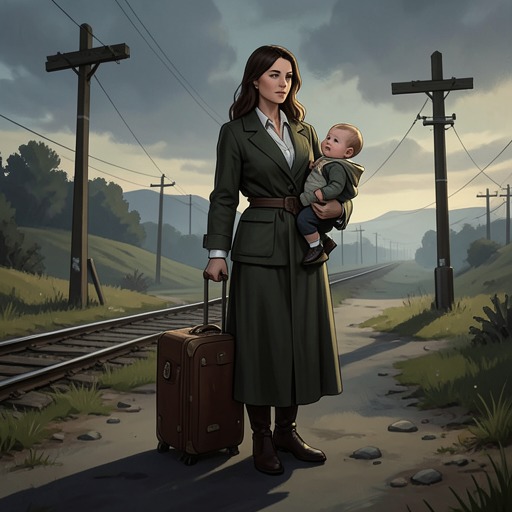
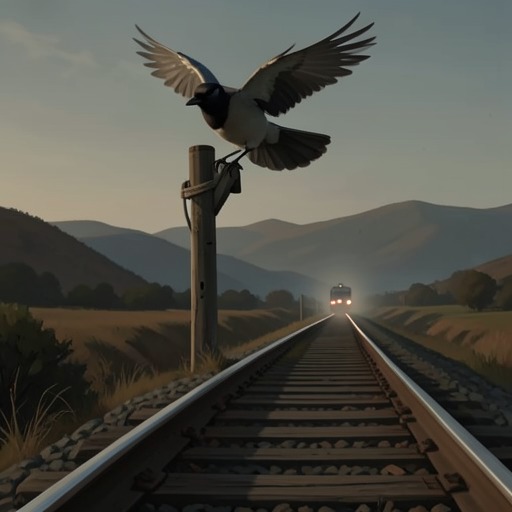
The wood lies close to Rachel’s home and the railway line. From the train, she can see it beyond the fields between the track and the tree line; it is also described as just down the road from where she is staying. For Rachel, this is not an isolated wilderness encountered once, but part of the landscape she crosses on her regular journeys. She travels along the line morning and evening, passing the fields without realizing that Megan is buried nearby.
That recurring view links Corly Wood to Rachel’s habitual use of the 8.04 train. The carriage offers her a moving vantage point over the houses and land beside the tracks, while the fixed route brings the same landscape past her again and again. When Rachel later reflects on the discovery, the ordinary repetition of those journeys becomes a measure of her ignorance: she had been travelling by the wood each day, unaware of what lay there. The wood’s proximity makes the concealment feel less remote, even as the passing train allows its passengers to remain distant from what is happening on the ground.
Discovery in the flooded field
On the morning of 1 August, Rachel sees a television report showing Corly Wood in heavy rain. At first she notices only fragments of the scene: cars, police tape, and a white tent. The report identifies the location as a field at the bottom of the wood, where dog walkers out early that morning found a young woman’s body submerged in flood water. The police have not yet formally identified her, but believe she is Megan, who disappeared on 13 July. The reporter also says the field is less than five miles from the Hipwells’ home and that Megan’s husband has been informed.
The report establishes a physical connection between the missing-person case and a landscape Rachel has repeatedly seen from the train. She recognizes the wood before she can fully take in what the police activity means; the familiar view becomes evidence of how close the unknown had been to her daily life. The body’s position in the flooded field, and the report that recent heavy rain may have uncovered a burial, make the weather consequential to the investigation: what had been hidden in the ground is exposed, though the circumstances of the death remain unresolved.
At this stage, the news says Megan’s identity is still unconfirmed and that the cause of death has not been established. Police also report no evidence of a sexual motive. Rachel distrusts that conclusion and, drawing on her own suspicions, believes Kamal Abdic may have wanted Megan and killed her when he could not have her. Her interpretation is not proof; it shows how the discovery at Corly Wood intensifies her effort to explain Megan’s death while the available information remains incomplete.
The wood as a place of concealment
Tom later describes taking Megan by car to Corly Wood on the night she disappeared. He says it was a place they had sometimes gone when they could not get a room. On this occasion, he says, he meant to talk with her after she threatened to bring the affair and her pregnancy into the open. His account places the wood within an existing private history between them, not merely as a random hiding place selected after the killing.
Tom admits that he struck Megan with a rock during their argument, then put her in the car boot and drove farther into the wood, away from the road. He says he dug a grave with his bare hands and buried her there. The ground was soft, but he could not dig as deeply as he wanted because he feared someone would come. He also says that he thought he might return later to move her, but heavy rain began and he never did. This account explains why the body was buried at Corly Wood and connects the shallow concealment to the weather that eventually helped expose it.
The setting also enters Rachel and Tom’s later movements. They drive to the wood’s car park, a place they have been before, and find it empty that evening. Tom tells Rachel that he and Megan used to go there together. The location therefore holds different kinds of familiarity for the two of them: for Rachel, it is part of the landscape and a place she has visited with Tom; for Tom, it is also bound to his secret relationship with Megan and to the burial he concealed there.
Narrative significance
Corly Wood gathers together the story’s repeated contrasts between seeing and knowing, movement and concealment. Rachel can see the wood from the train without recognizing it as the site of a crime; the television report turns that familiar view into a revelation, and Tom’s later admission supplies the hidden history behind it. The location’s closeness to the railway and to the homes of the people involved makes the murder neither distant nor wholly separate from ordinary life. It lies beside routes used every day, concealed in a place that has been passed, visited, and remembered for different reasons.
The wood’s role also changes as information accumulates. It first appears in the news as the scene of an uncertain discovery, with Megan’s identity and cause of death not yet formally established. Rachel’s suspicions then attach the site to a possible motive and suspect, before Tom’s account reveals that he brought Megan there, buried her, and expected the concealment to hold. The same field that had remained unnoticed from the train becomes the point where the investigation’s uncertainty gives way to a specific account of what happened.